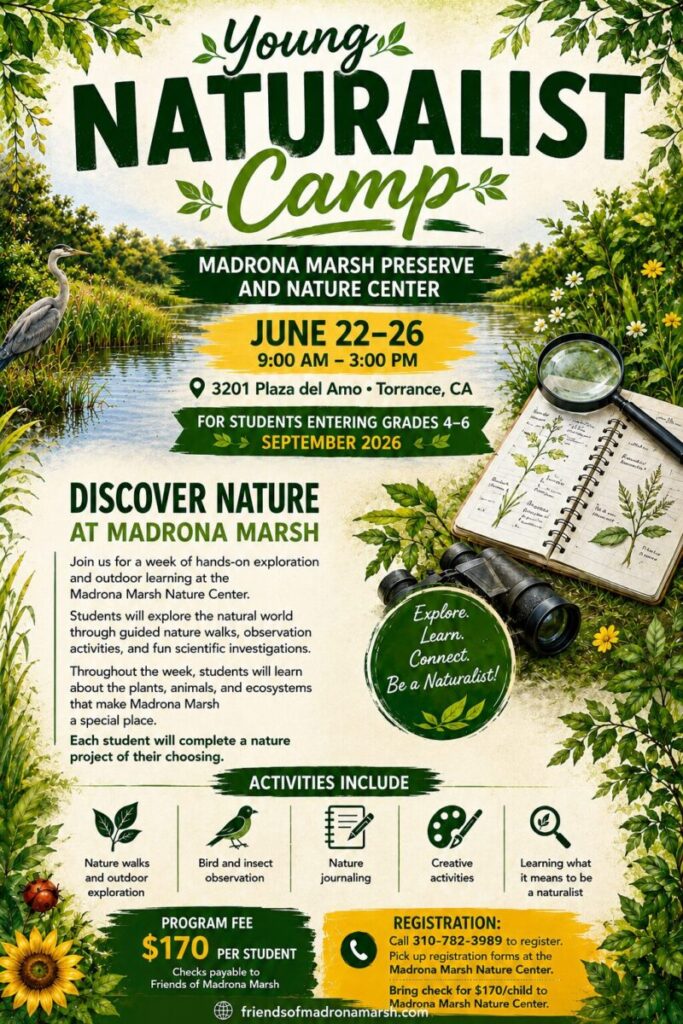
Welcome to the 2026 Young Naturalist Program for students entering grades 4–6 in September 2026. The program will take place at the Madrona Marsh Preserve and Nature Center, located at 3201 Plaza del Amo, Torrance, CA 90503. For additional information, please call 310-782-3989.
We are very excited that your child will be participating in this program. We have planned a week full of fascinating, exciting, educational, and fun activities for our Young Naturalists. We look forward to sharing our love of nature and environmental exploration with your child.
Arrival and Pick Up Information
Parents/guardians, please drop off and pick up your child each day in the Nature Center Classroom on time.
• Drop off: 9:00 AM
• Pick up: 3:00 PM
If someone other than a parent or caregiver will be picking up your child, that person must be at least 18 years old. Please provide written permission including the individual’s name.
Registration/Enrollment
The registration fee is $170 per student. The fee includes lunch and all program supplies for the week. The program is limited to 15 students. Payment is required to reserve a student’s place in the program. To enroll, please bring a check for $170 to the Madrona Marsh Nature Center. We also accept Zelle and Venmo.
Minimum Enrollment Requirement
A minimum of 10 students is required for the Young Naturalist Program. If minimum enrollment is not met, families will be notified approximately 3–4 days before the start date regarding any program cancellation.
Young Naturalist Goals
Through hands-on learning experiences, children will learn to appreciate, protect, and preserve our unique and diverse wildlife and habitats.
Program Details
Our week will rotate around group and individual activities that focus on different themes including soil, water, sun and energy, observation skills, map reading, birds, insects, mammals, plants, and how they work together to create an ecosystem. Each student will receive a journal for personal use throughout the week. Students will also complete a project of their choosing related to nature and Madrona Marsh. Each activity is designed to help students better understand what it means to be a naturalist while practicing the skills to become one.
The program provides a light lunch consisting of a prepackaged sandwich, fruit, chips, and cookies. Water will always be available.
Weekly Schedule
Day 1: Ecosystem Basics
Exploring the Nature Center, gardens, and preserve. Introduction to mapping, soil, plants, sunlight, and energy. Learning what it means to be a naturalist. Introduction and discussion of the independent project. Students may use different forms of media to promote nature, including storytelling, puppet shows, music, songs, videos, PowerPoint presentations, poetry, and art. Projects are due Friday.
Day 2: Insects and Reptiles
Observation and exploration activities focused on insects and reptiles found at Madrona Marsh.
Day 3: Birds
Bird observation, identification, and learning about bird habitats and behavior.
Day 4: Mammals of the Preserve
Exploration and discussion of mammals and their role within the ecosystem.
Day 5: Project Presentations and Nature Celebration
Finalizing and presenting independent projects. Awarding certificates to students completing the program and personal project. Nature games and group activities.
What to Bring
- Jacket, hat, and sunscreen. A good portion of our time will be spent outdoors on the Preserve.
- Closed-toe shoes.
- Comfortable clothing suitable for outdoor activities and nature exploration.
- Small snack (optional).
- Reusable water bottle.
- Small backpack for personal belongings.
- Markers or colored pencils for drawing and journaling activities.
- Students may bring an iPhone, tablet, or camera with the necessary charger only if needed for their project. Students are solely responsible for their equipment.
- Labeling your child’s belongings is highly recommended.
What Not to Bring
Please leave electronic games, iPods, fidget spinners, special toys, or other distracting items at home. These items may distract students from group activities and can become disruptive or unsafe during the program. Dangerous items that may be considered weapons, including matches or pocketknives, are not allowed.
Young Naturalist Behavior Expectations
- Stay within sight of the group at all times.
- Be respectful of teachers, staff, other students, and yourself.
- Keep your hands to yourself. Do not touch other people or their belongings without permission.
- Come prepared for the day’s activities with appropriate clothing and equipment.
- Apply sunscreen and bug spray at home before arriving.
- Help keep the Nature Center and Preserve clean by picking up your belongings and disposing of trash properly.
- Be willing to experience new activities, places, and friendships.
- DO NOT feed the animals at any time, including education animals.
Examples of Behaviors That Are Not Accepted
- Angry or vulgar language, including swearing, name calling, or shouting.
- Behavior that poses a safety risk to the student or others.
- Unwanted physical contact with another person.
- Harassment or intimidation through words, gestures, body language, or other threatening behavior.
- Disrespectful behavior toward group leaders, staff, volunteers, or other students.
- Theft or destruction of another person’s property.
Consequences of Unacceptable Behavior
- Your child will receive a warning and be redirected back to the group activities.
- Second occurrence — Your child may not be able to participate in the activity for the remainder of the day, and parents/guardians will be informed at pick up time.
- Third occurrence — Parents/guardians will be contacted, and the child may no longer be able to participate in the program. No refunds will be provided for exclusion due to unacceptable behavior.We want every child to feel comfortable, safe, and supported during the program. If your child is experiencing any difficulties during the week, please let us know. Our goal is to provide a fun, safe, and educational experience for all participants.
Health Issues / Emergency Procedures
Our program is designed to keep students active and outdoors for most of the day. Please monitor your child’s health each morning and do not bring a sick child to the program. A child who is ill may become uncomfortable and could expose other students and adults to illness. If your child becomes sick during the day, a parent/guardian or designated emergency contact will be contacted for pickup.
If a minor injury or health concern occurs and your child requires medical attention, the following procedures will be followed:
• Parents/guardians or family members will be informed of the incident at the end of the day unless immediate notification is necessary.
• First aid will be provided and the incident will be documented on an accident report form.
• The child will be continuously observed and cared for during and after first aid is provided.
In the event of a serious injury or health emergency requiring professional medical care:
• Parents/guardians or emergency contacts will be notified immediately.
• 911 emergency services may be contacted.
• A responsible adult may accompany the child to the hospital if a parent/guardian or emergency contact cannot be reached.
• The incident and any first aid provided will be fully documented.
If you prefer different emergency procedures for your child, please indicate them on the registration forms.
Our goal is to provide a wonderful, fun, and safe Young Naturalist Program with meaningful learning opportunities for all students. Get excited for a week of adventure!
To register, call 310-782-3989